Dicebound Quests: Heroes of Dice
About this game
Take a party of adventurers on a series of quests. Each quest has its own type of boss and its own deck of events, that will appear in random order. Each event has groups of targets that need to be filled by your adventurers that are represented by dice. Each target has specific requirements including what type of weapon it can be damaged by. Any targets or groups of targets not filled at the end of each turn cause damage to your party, and if your health reaches zero the quest has failed. You start with a party of nine adventurers composed of five different hero types:
Yellow Knights - Skilled with swords. They have a special skill, which when available, can shield the entire party.
Green Rangers - Skilled bowman. Their special skill is precision, and when available, they can adjust their value up or down by one.
Blue Wizards - Skilled in magic. Their special skill is a local time warp, which when available, allows them to reroll themselves.
Black Warlocks - They can use any weapon at any time. They use magic, short swords, and short bows, and can be used on any type of target.
Red Clerics - There is only one in the realm, but he is one of the most important party members, because he can heal the entire party. In addition, even though he isn't as strong as the other members, he can use any weapon, such as his magic staff, dagger, and small crossbow, to fight any target.
The party starts with a small set of skills and equipment, that is different for each quest. These skills allow you to manipulate the dice. For example:
Backpack - Stores dice for future turns.
Fireball Scroll - Converts a die into another type of die ranging from a D4 to a D20 and then rerolls it. There are also variants of this skill specifically for Knights, Rangers, and Wizards.
Warlock Scroll - Allows any die to be used on any target.
Cooperation - Any dice adding up to a value of at least four, can be traded for a four of each color.
Cooperation Warlock Scroll - Any dice adding up to a value of at least four, can be traded for a 5 of the same color plus a warlock ranging from a D8 to a D20.
Second Wind - Allows you to reuse any skill. Most skills can be used once per event.
Reroll - Allows you to reroll a die. Two dice will be rolled, and you can choose one. This can be used twice per event, and when upgraded will roll three dice to choose from.
And there are several more, for a total of thirteen skill types with twenty-five variations. And most can be upgraded to make them even more useful, with from one to five levels of upgrades.
After completing each event, the party can choose a reward, which can be a new party member, a new skill, or experience points which are used to upgrade skills. Skills can be upgraded, downgraded, or traded for experience points at any time, as long as they haven't been used during the current event.
There are eight quests, plus a custom quest that allows you to select any party, location, or boss from any of the basic quests that you have already played. You can also create a custom party with a custom set of starting skills, and you can choose a combination of all locations and/or random bosses. Each quest location and boss has a few of its own special rules. The quests include:
Castle - Take the local castle back from a group of Ogres and their various allies. Everyone's special skill always works in the castle, because they are all familiar with it and comfortable there.
Forest - Clear a pack of werewolves out of the forest. The ranger's special skill always works in the forest, because they are happiest in a forest. There will be more rangers to recruit in the forest than other hero types.
Swamp - Search for a treasure in the swamp protected by Hydras. The knight's special skill never works in the swamp, since their armor is too heavy for the soft swampy ground. There will be fewer knights to recruit in the swamp.
Ruins - Fight a group of Necromancers who are terrorizing the nearby ruins. The knight's skill always works in the ruins because it is where jousting tournaments used to be held before being destroyed by war. There will be more knights to recruit there.
Mountains - Defeat a group of dragons who have descended on the mountains. The wizard's skill always works in the mountains because it is a magical place where many of them trained. There will be more wizards to recruit there
Cavern - Destroy Medusa and her sisters in a deep dark cavern filled with strange creatures. The Ranger's skill never works in the dark twisted passageways of the caverns. There will be fewer rangers to recruit there.
Dark Mage's Castle - Destroy a group of golems that are guarding the abandoned Dark Mage's Castle. The wizard's skill never works in the Mage's castle due to the dark and strange magic that is infused throughout it. There will be fewer wizards to recruit in the Mage's castle.
Wastelands - Search for mythical treasure in the wastelands guarded by Giant Scorpions. Everyone's special skill only works half the time that it would anywhere else.
Each quest consists of three levels. The party has a set amount of time to experience events before a boss appears at the end of the level. There will be one boss at the end of level 1, two bosses at the end of level 2, and three bosses at the end of level three. Each new level increases the number of location targets and the damage done by the target groups, making each level harder than the last. Defeating the three bosses at the end of level 3, wins the game. The amount of damage done each turn by the three bosses at the end is extremely high, so the party must accumulate enough party members, skills, and experience points to upgrade those skills, so that they can handle the final bosses and survive.
Bonus points are rewarded after each run and are tracked per location. When accumulated they give the player up to four bonus items that can be used in future runs at that location. Bonus items include extra healing for clerics, a bonus starting skill, extra experience, and level two skills for various party members.
A score is calculated at the end of each run and tracked locally for each of five player profiles in 20 different categories, such as Overall high score, and for each difficulty level and each quest type. A High Scores page shows the high scores for both the current player and for every player profile combined in each category. The highest scores in each category are added to a Steam leaderboard. So, each player can compete against their own old scores, the scores of other local player profiles, their Steam friends, and everyone on the leaderboards. The fastest runs for both of two game modes are also tracked.
There are two game modes, normal mode and fast mode. Fast mode allows the player to trade unused skills, skill levels, and experience for healing, even during battle, but provides less time to accumulate resources during each level. Normal mode only allows trading for healing between battles but allows more time to accumulate resources during each level.
There are four difficulty levels, plus a custom level for each game mode. Everyone should be able to find a difficulty level that suits them. The custom difficulty allows you to adjust eight different game settings to fit your playing style and can be used to make the game very easy, very difficult, or anywhere in-between.
There are many game and dice statistics tracked and shown for those that are interested, including: The number of quests played and won; The total time and dice rolled; The min, max, and average scores, health remaining, time used, and dice rolled per run; The number of bosses defeated, and events completed; The dice rolled and the number of times each die value was rolled for every die type; The targets and skills that dice were used on; And a graph and fairness analysis of all the rolls of each die type.
There are Steam achievements that can be unlocked for things like: playing and winning all quest types; Winning on the different difficulty levels; Playing and winning X number of runs; and Rolling X number of dice rolls.
Although there is luck involved due to dice being rolled and event cards being drawn, there is plenty of strategy in how you use those rolls, and which resources you accumulate so that you can take advantage of whatever dice you roll. Runs tend to take from 45 minutes to an hour to complete.
All code was written by hand, but AI was used to generate images. I am a single person developer/publisher who is a retired software engineer and have been writing code my entire life. But even though I am an aspiring artist, I don't yet have the skill necessary to create all the required images quickly enough.
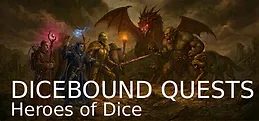
Command a party of dice adventurers and master their skills to conquer quests through castles, caverns, and cursed lands against Ogres, Dragons, and other deadly foes.